NeuroCAPs: Neuroimaging Co-Activation Patterns#










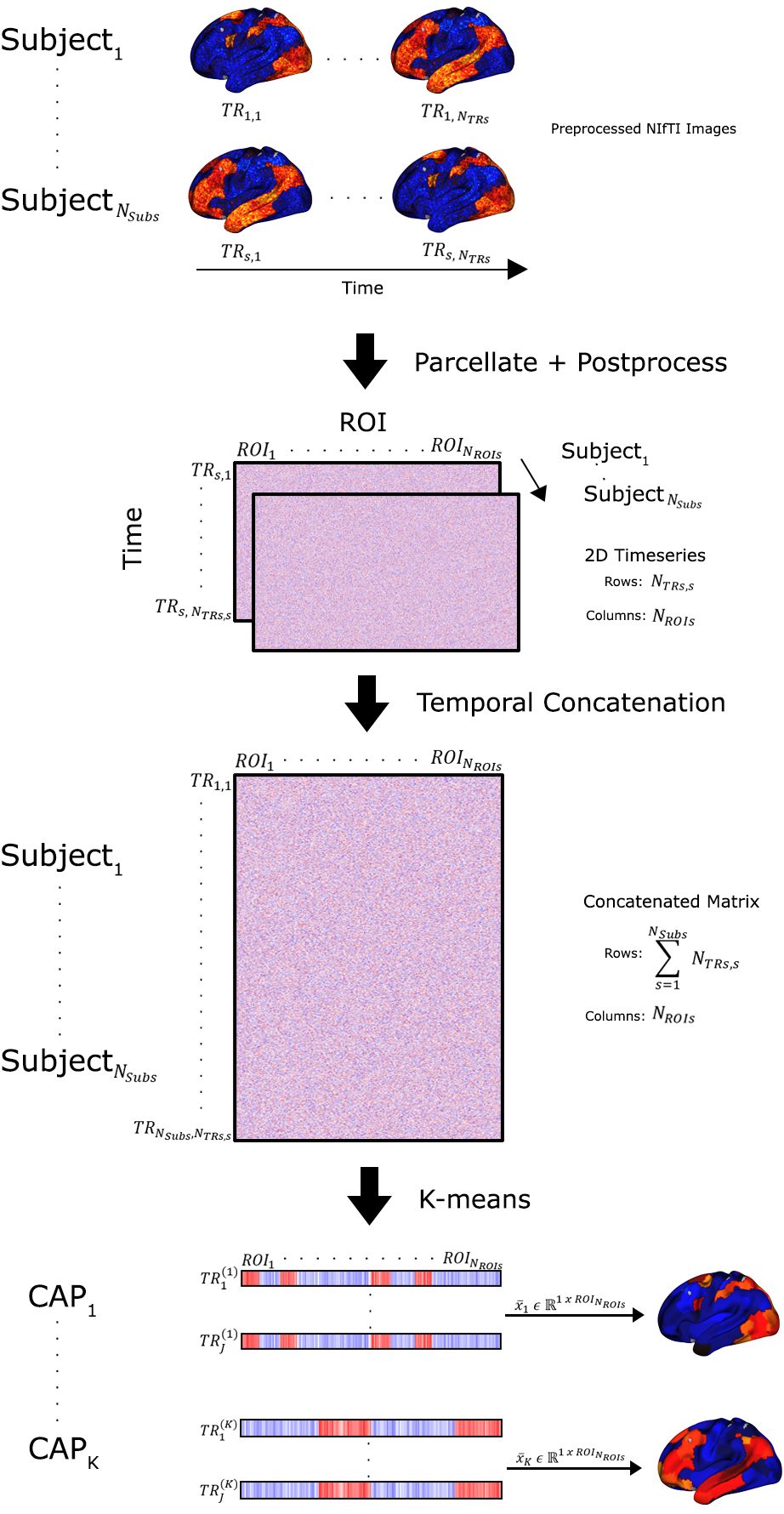
NeuroCAPs (Neuroimaging Co-Activation Patterns) is a Python package for performing Co-Activation Patterns (CAPs) analyses on resting-state or task-based fMRI data. CAPs identifies recurring brain states by applying k-means clustering on BOLD timeseries data [1].
Citing#
Smith, D. (2024). NeuroCAPs. Zenodo. https://doi.org/10.5281/zenodo.15914495
Usage#
NeuroCAPs is built around two main classes (TimeseriesExtractor and CAP) and includes several
features to perform the complete CAPs workflow from postprocessing to visualizations.
Notable features includes:
Timeseries Extraction (
TimeseriesExtractor):extracts BOLD timeseries from resting-state or task-based fMRI data.
supports deterministic parcellations such as the Schaefer and AAL, in addition to custom-defined deterministic parcellations.
performs nuisance regression, motion scrubbing, and additional features
reports quality control information based on framewise displacement
Important
NeuroCAPs is most optimized for fMRI data preprocessed with [fMRIPrep](https://fmriprep.org/en/stable/) and assumes the data is BIDs compliant. Refer to [NeuroCAPs’ BIDS Structure and Entities Documentation](https://neurocaps.readthedocs.io/en/stable/bids.html) for additional information.
CAP Analysis (
CAP):performs k-means clustering on individuals or groups
identifies the optimal number of clusters using silhouette, elbow, davies bouldin, or variance ratio methods
Utilities:
plot transition matrices
merges timeseries data across tasks or session
generates the custom parcellation dictionary structure from the parcellation’s metadata file
fetches preset custom parcellation approaches
Refer to the demos to the demos or tutorials for an extensive demonstration of the features included in this package.
Dependencies#
NeuroCAPs relies on several packages:
dependencies = [
   "numpy>=1.26.3",
   "pandas>=2.1.0",
   "joblib>=1.3.0",
   "matplotlib>=3.6.0",
   "seaborn>=0.11.0",
   "kneed>=0.8.5",
   "nibabel>=5.0.0",
   "nilearn>=0.10.4",
   "scikit-learn>=1.4.0",
   "scipy>=1.10.0",
   "brainspace>=0.1.16",
   "surfplot>=0.2.0",
   "neuromaps>=0.0.5",
   "pybids>=0.16.5; platform_system != 'Windows'",
   "plotly>=5.19.0, !=6.1.0, <=6.1.2",
   "nbformat>=5.10.0",
   "kaleido==0.1.0.post1; platform_system == 'Windows'",
   "kaleido>=0.2.0, <1.0.0; platform_system != 'Windows'",
   "setuptools>=77.0.1; python_version>='3.12'",
   "typing_extensions>=4.10.0",
   "vtk>=9.2.0, <9.4.0",
   "tqdm>=4.65.0"
   ]
Acknowledgements#
Some foundational concepts in NeuroCAPs take inspiration from features or design patterns implemented in other neuroimaging Python packages, specifically:
mtorabi59’s pydfc, a toolbox that allows comparisons
among several popular dynamic functionality methods. - 62442katieb’s IDConn, a pipeline for assessing individual differences in resting-state or task-based functional connectivity.
References#
distinct fMRI co-activation patterns. Frontiers in Systems Neuroscience, 7. https://doi.org/10.3389/fnsys.2013.00101