Tutorial 1: Using neurocaps.extraction.TimeseriesExtractor
The purpose of this module is to perform timeseries extraction, cleaning, and visualization. Additionally, it is used to create the necessary dictionary structure needed for CAP. Technically, this dictionary structure can be manually created if the BOLD images where not preprocessed using fMRIPrep. Output from the Extracting Timeseries section is from a test from Github Actions using a truncated version of an open dataset provided by Laumann & Poldrack and used in Laumann et al., 2015 [1] was also utilized. This data was obtained from the OpenfMRI database, accession number ds000031.
Extracting Timeseries
from neurocaps.extraction import TimeseriesExtractor

dir = os.path.dirname(__file__)

"""If an asterisk '*' is after a name, all confounds starting with the
term preceding the parameter will be used. in this case, all parameters
starting with cosine will be used."""

confounds=["Cosine*", "aComp*", "Rot*"]

parcel_approach = {"Schaefer": {"n_rois": 100, "yeo_networks": 7, "resolution_mm": 2}}

extractor = TimeseriesExtractor(parcel_approach=parcel_approach,
                                standardize="zscore_sample",
                                use_confounds=True,
                                detrend=True,
                                low_pass=0.15,
                                high_pass=0.01,
                                confound_names=confounds)

bids_dir = os.path.join(dir, "ds000031_R1.0.4_ses001-022/ds000031_R1.0.4")

# Can use the `n_cores` parameter for multiprocessing
pipeline_name = "fmriprep_1.0.0/fmriprep"

extractor.get_bold(bids_dir=bids_dir,
                   session="002",
                   task="rest",
                   pipeline_name=pipeline_name,
                   tr=1.2)
2024-11-02 20:35:47,797 neurocaps._utils.extraction.check_confound_names [INFO] Confound regressors to be used if available: Cosine*, aComp*, Rot*.
2024-11-02 20:35:48,898 neurocaps.extraction.timeseriesextractor [INFO] BIDS Layout: ...0.4_ses001-022\ds000031_R1.0.4 | Subjects: 1 | Sessions: 1 | Runs: 1
2024-11-02 20:35:48,941 neurocaps._utils.extraction.extract_timeseries [INFO] [SUBJECT: 01 | SESSION: 002 | TASK: rest | RUN: 001] Preparing for Timeseries Extraction using [FILE: sub-01_ses-002_task-rest_run-001_space-MNI152NLin2009cAsym_desc-preproc_bold.nii.gz].
2024-11-02 20:35:48,946 neurocaps._utils.extraction.extract_timeseries [INFO] [SUBJECT: 01 | SESSION: 002 | TASK: rest | RUN: 001] The following confounds will be used for nuisance regression: Cosine00, Cosine01, Cosine02, Cosine03, Cosine04, Cosine05, Cosine06, aCompCor00, aCompCor01, aCompCor02, aCompCor03, aCompCor04, aCompCor05, RotX, RotY, RotZ.
print(extraction.subject_timeseries)
 {'01': {'run-001': array([[-0.12410211, -0.746016  , -0.9138416 , ...,  0.12293668,
 -0.3167036 , -0.4593077 ],
[-1.0730965 ,  0.88747275,  0.83726895, ..., -0.9314818 ,
  0.5686499 ,  0.9783575 ],
[-0.5288149 ,  0.62266237,  0.6349383 , ..., -0.5331197 ,
  0.5261529 ,  0.5858582 ],
...,
[ 0.32443312, -0.42479128, -0.43596116, ...,  0.5425763 ,
 -0.2863486 , -0.31798226],
[ 0.94420713, -0.7662241 , -0.6925075 , ...,  1.7636685 ,
 -0.4194046 , -0.5691561 ],
[ 0.4901481 ,  0.33806482,  0.48850006, ..., -0.29197463,
 -0.08600576, -0.08736482]], dtype=float32)}}
Saving Timeseries
extractor.timeseries_to_pickle(output_dir=dir,
                               file_name="task-positive_Schaefer.pkl")
Visualizing Timeseries
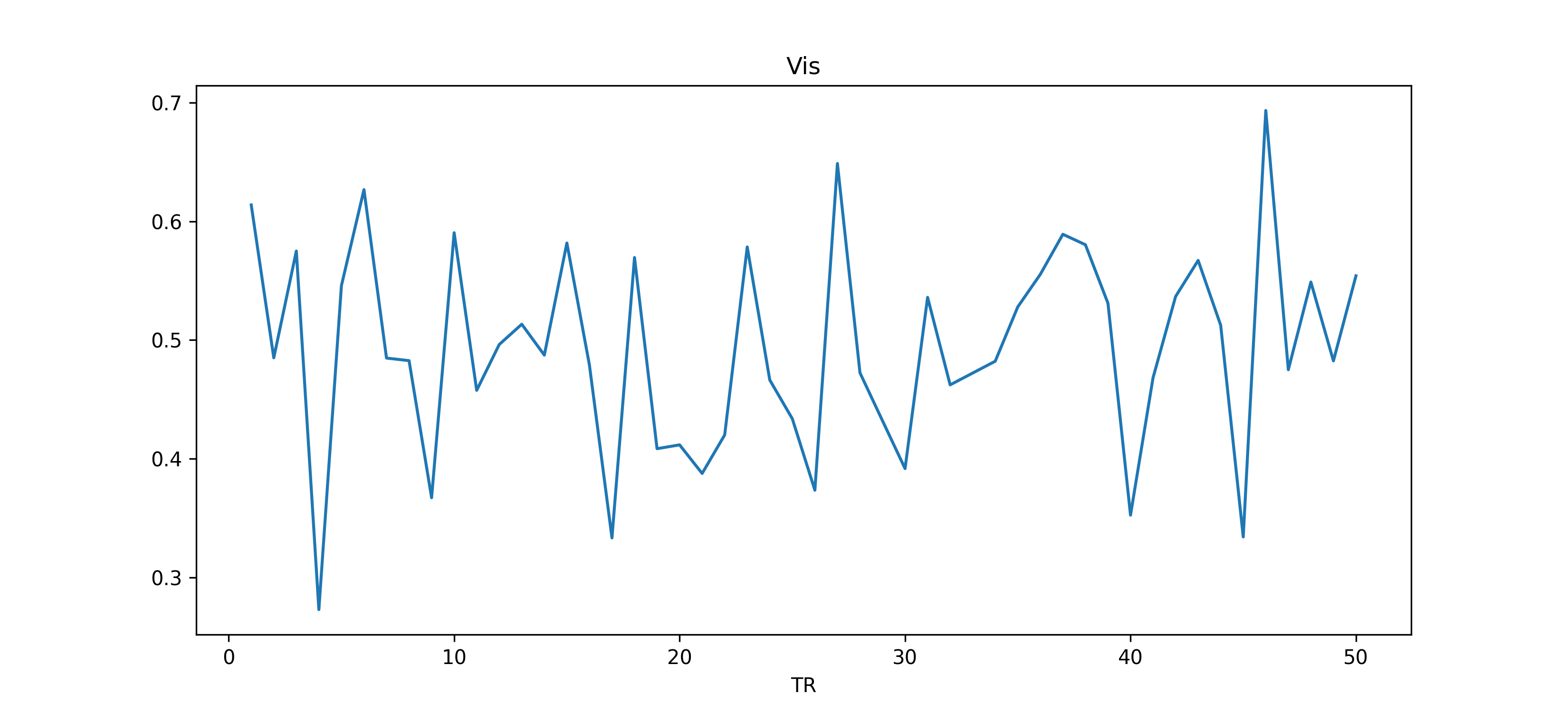
# Visualizing a region
extractor.visualize_bold(subj_id="01", region="Vis")
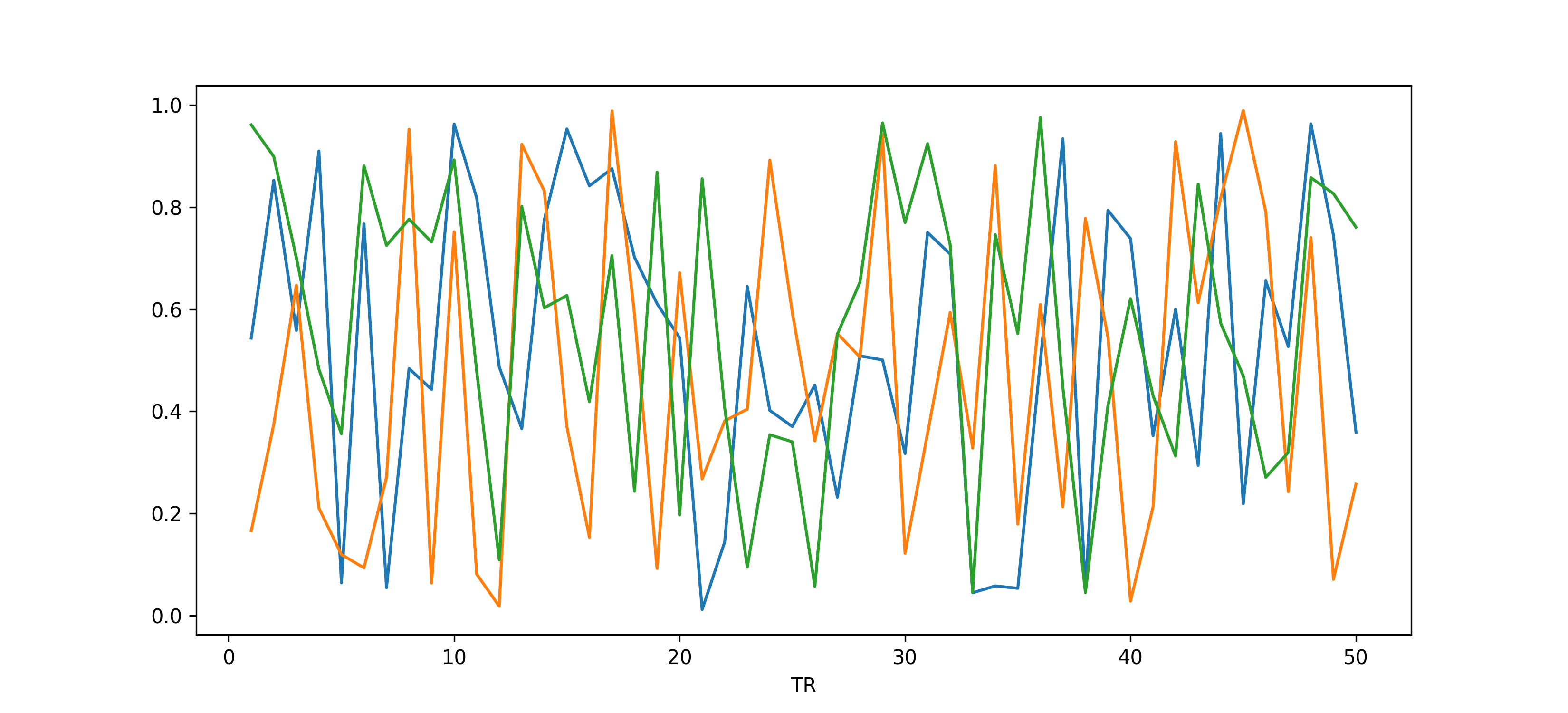
# Visualizing a several nodes
extractor.visualize_bold(subj_id="01",
                         run="001",
                         roi_indx=[0, 1, 2])
# or
extractor.visualize_bold(subj_id="01",
                         run="001",
                         roi_indx=["LH_Vis_1", "LH_Vis_2", "LH_Vis_3"])